Contact Us

Phone
${phone}

Email
info@repsmovement.com.au

Address
${address}

Online Enquiry

* Required fields

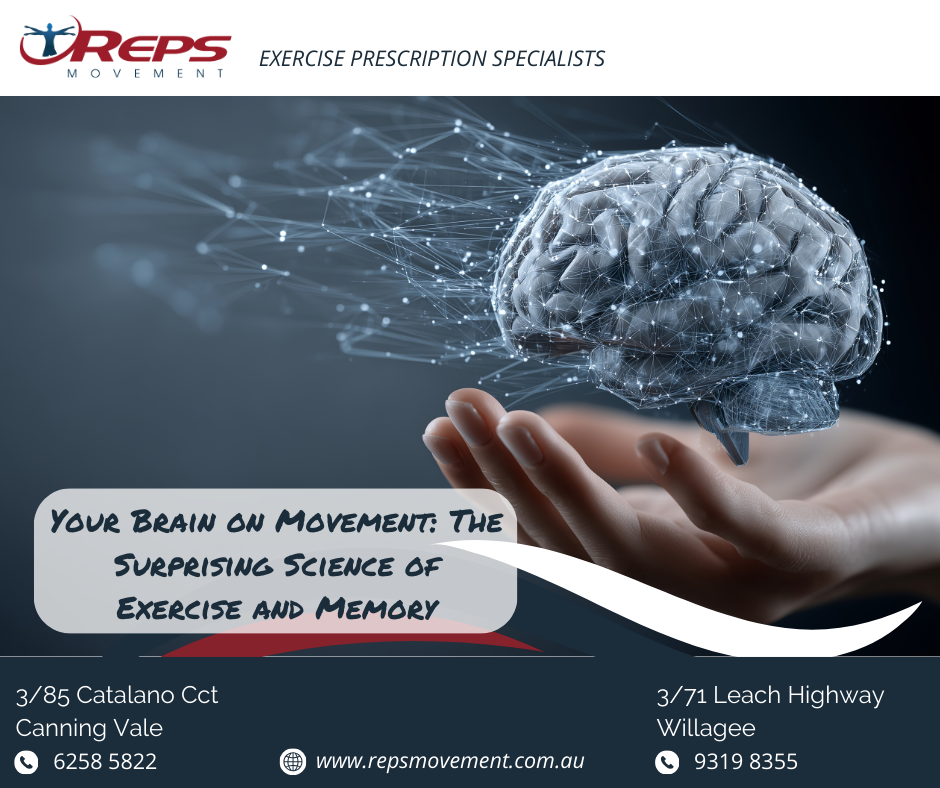
30 Minutes to a Sharper Memory: The Science Behind Exercise & Your Brain

19/01/2026

Have you ever walked into a room and completely forgotten why you're there? Or struggled to recall someone's name moments after being introduced? If this sounds familiar, you're not alone. Memory lapses are one of the most common concerns we hear from clients.
Here's what might surprise you: the solution isn't brain training apps, crossword puzzles, or expensive supplements. The most powerful tool for protecting and enhancing your memory is something far simpler—movement.

What Your Doctor Might Not Tell You About Exercise and Your Brain

Most of us know exercise is good for our hearts, our waistlines, and our general health. But the research on exercise and brain function? It's nothing short of remarkable—and it's research that's transforming how we think about cognitive health across the lifespan.

A groundbreaking 2025 study from the University of South Australia analyzed 133 systematic reviews covering over 258,000 participants. The findings were clear: exercise significantly improves general cognition, memory, and executive function in both healthy individuals and those with clinical conditions. Even more encouraging? The benefits appeared across all age groups, from children to older adults.

But here's where it gets really interesting: you don't need to become a marathon runner to see results. The same research found that low- to moderate-intensity exercise had the greatest cognitive benefits. We're talking about brisk walking, dancing, or even climbing a few flights of stairs—activities that get your heart rate up but don't leave you gasping for breath.

The Remarkable Story of What Happens Inside Your Brain

Think of your brain as a sophisticated garden that needs regular tending. Without care, certain areas begin to shrink—particularly a seahorse-shaped region called the hippocampus, which is crucial for forming and storing memories. In fact, after age 50, the hippocampus typically shrinks by about 1-2% each year. This gradual decline is associated with memory problems and increased dementia risk.

Now here's the exciting part: exercise can actually reverse this process.

Research from the University of Pittsburgh showed that just one year of aerobic exercise increased hippocampal volume by 2% in older adults—effectively turning back the clock by one to two years. But the changes didn't stop there. Those who exercised also showed improvements in spatial memory, the type of memory that helps you navigate your environment and remember where you left your keys.

What's Good for the Heart Is Good for the Brain

Much of exercise's brain-protective power comes from its cardiovascular benefits. When you engage in aerobic activity:

Blood Flow Increases: Your elevated heart rate pumps more oxygen-rich blood to the brain, nourishing neurons and supporting the health of white matter—the brain's communication network. This enhanced circulation also maintains the myelin sheaths that insulate nerve fibers, ensuring signals travel efficiently throughout your brain.

Vascular Health Improves: Exercise strengthens and protects blood vessels throughout your body, including the delicate vessels in your brain. Healthier vessels mean better nutrient delivery, more efficient waste removal, and reduced risk of the small strokes that contribute to cognitive decline.

Metabolic Function Optimises: Regular physical activity improves how your brain processes and uses energy. Your brain becomes more efficient at using glucose (its primary fuel), and insulin signaling improves—a crucial factor since insulin resistance in the brain is increasingly recognized as a contributor to cognitive decline.

Why This Matters: Your hippocampus isn't just important for remembering facts and events. It's central to your ability to learn new things, navigate your world, and maintain independence as you age. When we can measurably grow this brain region through exercise while simultaneously improving the vascular system that supports it, we're not just improving memory—we're investing in comprehensive, long-term cognitive resilience.

The Molecular Magic: How Movement Transforms Your Mind

You might be wondering: how does moving your muscles change your brain? The answer lies in a protein called brain-derived neurotrophic factor, or BDNF—essentially fertiliser for your brain.

When you exercise, your muscles and brain ramp up BDNF production. This crucial molecule promotes the birth of new brain cells (even in adulthood), strengthens connections between neurons, and protects existing cells from decline. Recent research shows that exercise increases BDNF levels specifically in brain regions critical for memory—the hippocampus and prefrontal cortex.

The mechanism is elegant: when you exercise, your muscles produce a metabolite called beta-hydroxybutyrate that travels to your brain and triggers BDNF production. Your muscles also release a hormone called irisin that crosses into the brain, protecting neurons against inflammation and toxic proteins associated with Alzheimer's. The result? New neurons grow, existing connections strengthen, and your capacity for learning and memory expands.

The Timeline: When Can You Expect Results?

The research offers encouraging answers. Recent studies show that:

  • Immediately: Even a single 10-minute bout of light exercise can improve connectivity between memory-processing areas of your brain
  • Within 24 hours: The cognitive boost from exercise can persist into the next day, particularly when paired with quality sleep
  • After 12 weeks: Consistent exercise programs show measurable improvements in memory and cognitive function
  • One year: Significant structural changes in the brain become evident, including increased hippocampal volume

What's striking is you don't need to wait months. A 2024 study found that memory-enhancing effects lasted up to 24 hours after a workout. Your morning walk sets you up for better memory tomorrow, too.

Not All Exercise Is Created Equal (But Most Types Help)

The comprehensive 2025 research revealed some fascinating specifics about which types of exercise offer the greatest cognitive benefits:

Resistance training also contributed to cognitive improvements, particularly when combined with aerobic activity.
Aerobic exercise like walking, cycling, or swimming consistently improved executive function—your ability to plan, focus, and make decisions.
Mind-body exercises like Tai Chi and yoga showed the most significant impact on memory. These activities combine physical movement with focused attention and breath control, potentially offering a double benefit for brain health.
Exergames (think Pokémon Go or active video games) were highly effective for general cognition, particularly in older adults. The combination of physical activity and cognitive engagement appears to create synergistic benefits.

The common thread? Activities that elevate your heart rate and increase blood flow to the brain. The specific form matters less than finding something you'll actually do consistently.

Why This Matters More Than Ever

We're facing a growing crisis in cognitive health. In Australia, approximately 433,000 people are currently living with dementia—that's around 16 in every 1,000 Australians. Without significant intervention, this number is projected to more than double to 1.1 million by 2065. The personal and societal costs are staggering.

Yet here's the hopeful reality: physical activity can reduce your risk of developing dementia by 30-40%. Even modest amounts—as little as 35 minutes of moderate activity per week—are associated with significant risk reduction. This isn't a marginal benefit; it's one of the most powerful preventive interventions we have.

How does exercise offer this remarkable protection? The mechanisms are multifaceted:

Clearing "Brain Debris": Exercise improves the health of blood vessels, helping your brain essentially "clear out the pipes." This may reduce the buildup of amyloid plaques and tau tangles—the hallmark proteins of Alzheimer's disease that accumulate in the brain and disrupt normal function.

The Irisin Connection: When you exercise, your muscles release a hormone called irisin. Recent research suggests this muscle-derived hormone can cross into the brain, where it protects neurons against the neuroinflammation and toxic proteins associated with Alzheimer's. Think of it as your muscles sending protective signals directly to your brain.

Metabolic Protection: Exercise dramatically improves insulin sensitivity in the brain. This matters because high blood sugar and insulin resistance are increasingly linked to cognitive decline—some researchers even refer to Alzheimer's as "Type 3 Diabetes" due to the brain's impaired ability to use glucose. Better insulin signaling means your brain cells can efficiently fuel themselves and maintain healthy function.

A 2025 meta-analysis focusing on Alzheimer's patients found that exercise interventions improved cognitive function through these multiple mechanisms—enhancing cerebral blood flow, reducing inflammation, supporting the brain's own repair systems, and potentially slowing disease progression.

This isn't about promising miracle cures. It's about recognizing that the way we move our bodies profoundly influences the health of our minds. And unlike many medical interventions, exercise comes with a remarkable bonus: it improves nearly every other aspect of health simultaneously.

Moving Beyond Common Misconceptions

"I'm too old to benefit from exercise now."
Studies show previously sedentary older adults who begin exercising experience significant cognitive improvements. It's never too late.
"I need intense workouts for brain benefits."
Low- to moderate-intensity exercise showed the greatest cognitive effects. A brisk 30-minute walk can be transformative.
"Brain games are just as effective as exercise."
While mental stimulation has value, exercise creates broad improvements across multiple cognitive domains that brain training alone cannot match.

Getting Started: Practical Guidelines

Intensity: Moderate intensity is ideal—you should be able to hold a conversation but not sing. This typically means 60-70% of your maximum heart rate.
Progression: Start where you are. Even 10-minute sessions show benefits. Gradually build toward the recommended doses over weeks or months.
Variety: Combining aerobic exercise with strength training offers comprehensive brain benefits. Add mind-body practices like Tai Chi or yoga for additional memory enhancement.
Consistency: Regular exercise over weeks and months creates the most significant changes. Aim for something you can sustain long-term rather than intense bursts followed by inactivity.

The key is finding activities that fit your current abilities and gradually building from there. Whether it's walking, swimming, dancing, gardening, resistance training, or group exercise classes, the best exercise for your brain is the one you'll actually do consistently.


The REPS Movement Approach to Brain Health

At REPS Movement, we understand that exercise isn't one-size-fits-all—especially when you're working with existing health conditions, pain, or movement limitations.

Our Exercise Physiologists are trained in the latest research on exercise and brain health. We create individualised exercise prescriptions based on your current health status, goals, and capabilities. Whether you're managing chronic conditions, recovering from injury, or simply want to protect your cognitive function as you age, we design programs that are both safe and effective.

We understand the science of neuroplasticity and which exercise parameters optimize BDNF production. More importantly, we understand the barriers that might be keeping you from exercising and create supportive environments where you can move confidently.

Whether you're ready to start fresh in 2026 or taking the first step back after time away, we're here to make it easy. These time-limited offers won't last—don't miss your chance to make 2026 your strongest year yet.

Call 9319 8355 / 6258 5822 to book your consultation today.