Contact Us

Phone
${phone}

Email
info@repsmovement.com.au

Address
${address}

Online Enquiry

* Required fields

Life After a New Joint: What Comes Next After Hip or Knee Replacement

24/11/2025
You've done the hard part – you made the decision, went through surgery, and now you have a shiny new hip or knee. The surgeon says it was a success, the hospital physio got you walking, and you're home healing. But now you're wondering: what happens next?

Maybe you've noticed that while the joint pain that plagued you for years is finally gone, you don't feel quite like yourself yet. Your leg feels weak, getting up from a chair takes more effort than you expected, and you're walking carefully, cautiously, as if your body isn't quite sure this new joint can be trusted. If this sounds familiar, you're not alone – and here's what we want you to know: this is completely normal, and it doesn't have to stay this way.

The Surgery Was Just the Beginning

Joint replacement is remarkably effective at relieving pain, with most people experiencing significantly less day-to-day discomfort and improved mobility compared to before surgery. But what many people don't realise is that the surgery itself is only the first step in getting back to the life you want.

Think of your new joint like a fresh set of tyres on a car that hasn't been driven properly in years. The tyres might be perfect, but the engine, suspension, and steering have all adapted to compensate for the old worn-out parts. Your body has done exactly the same thing, and it takes targeted work to retrain all those systems. Pre-surgery muscle fitness, surgical approaches, postoperative rehabilitation protocols, and your commitment to exercise programs all influence how well and how quickly you recover.

The months and even years leading up to surgery likely involved reduced activity, altered movement patterns, and progressive muscle weakness – not just around the joint, but throughout your whole body. That history doesn't disappear the moment you leave the operating theatre.

What Recovery Actually Looks Like

Understanding realistic timelines can help you stay motivated through the process. Moving early helps prevent blood clots and promotes healing, with physical therapy exercises beginning in the first days after surgery. Most patients notice significant improvements in pain and mobility by the six-week mark, though the journey varies considerably from person to person.

The first few weeks focus on managing swelling, regaining basic movement, and getting confident with walking aids. By the end of week two, most patients notice meaningful improvements in mobility and daily function. Weeks three to twelve are where the real rebuilding happens – the focus shifts from early mobility to building strength and restoring normal function. Many patients transition from walkers to canes during this period, and some may even begin walking short distances without assistance.

Three months is often when you'll feel you've turned a corner. People tend to see their biggest improvements after this milestone, though full recovery can take up to a year. Hip replacement patients may regain much of their pre-surgery strength and endurance by three months, while knee replacement patients may take the full three months to return to most activities, with complete recovery potentially extending to twelve months.

The key message here? Recovery is measured in months, not weeks – and the quality of that recovery depends heavily on what you do during this time.

Why Some People Get Stuck

Here's something that doesn't get talked about enough: sometimes the biggest barrier to recovery isn't the joint itself – it's the fear of using it. Research shows that between 24 and 40 percent of patients experience significant fear of movement following knee replacement. This "kinesiophobia" isn't weakness or imagination – it's your brain trying to protect you based on years of pain signals from that joint.

The problem is that this fear has been shown to have a significant relationship with limited knee bending, reduced functioning, increased pain, and even longer hospital stays. Fear-avoidance happens when someone begins to associate certain movements with pain or harm, even if those movements are now physically safe. The less they move, the more strength and mobility they lose, and their nervous system can become increasingly on guard, heightening pain sensitivity.

It becomes a self-reinforcing cycle: caution leads to reduced activity, reduced activity leads to weakness and stiffness, which makes movement feel harder and scarier – confirming the original fear and keeping people trapped in a pattern that limits their recovery.

Breaking the Cycle

The good news? There is strong evidence that exercise training is effective for reducing fear-avoidance. The key is progressive, guided movement that rebuilds both physical capacity and confidence simultaneously.

This is where working with an Exercise Physiologist makes a real difference. We help clients rebuild trust in their bodies through carefully guided, progressive movement – starting where you are and gradually building capacity without triggering flare-ups or setbacks. Unlike generic exercise programs, rehabilitation after joint replacement needs to address the whole picture: strength (rebuilding the muscles that support and move your new joint), balance (retraining the systems that keep you stable and confident), movement patterns (helping your body "unlearn" the compensations it developed over years of pain), and confidence (proving to your brain, through successful movement experiences, that your joint can be trusted).

Research suggests that hip abductor strength may have a stronger correlation with functional performance than quadriceps strength alone – meaning that comprehensive rehabilitation looking at the whole kinetic chain, not just the operated joint, leads to better outcomes and a more complete recovery.
 

Why This Matters

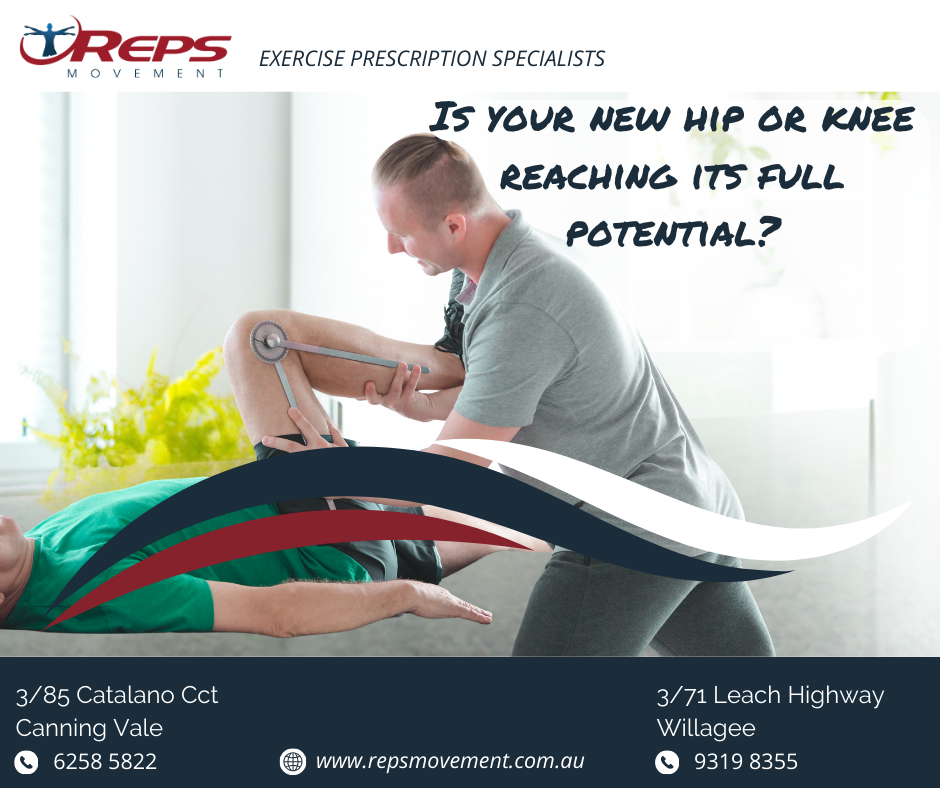
Your new joint has the potential to last 20-30 years and give you back activities you may have given up on, but potential doesn't become reality without action. A new hip or knee joint doesn't work by itself – getting the most out of your new parts requires a commitment to an exercise program, and that work continues long after the last physical therapy appointment ends.

The decisions you make now – to stay active, to push through the uncomfortable early months, to rebuild properly rather than just "getting by" – will determine what your life looks like in one year, five years, and beyond. This is your opportunity to not just recover, but to build a stronger, more capable version of yourself than you've been in years.

Your Next Steps

Already working with us? Talk to your Exercise Physiologist about incorporating joint replacement-specific programming into your sessions. Whether you're preparing for surgery or recovering from one, we can tailor your program to address your specific needs and goals.

Haven't seen us in a while? Life after joint surgery is the perfect time to reconnect. We understand that recovery can feel uncertain, and we're here to provide the structure, expertise, and encouragement you need to get the most from your new joint.

New to REPS Movement? Post-surgical rehabilitation is one of the most rewarding areas we work in – and one where the expertise of an Exercise Physiologist truly shines. Book a comprehensive assessment and let us help you build a recovery plan that's based on current evidence and tailored to your goals. Whether you're accessing services through Medicare, My Aged Care, NDIS, workers compensation, or privately, we can guide you through the options.

Your surgeon gave you a new joint. Now let us help you build a new life around it.


Call

📞 9319 8355 [Willagee]

📞 6258 5822 [Canning Vale]