Contact Us

Phone
${phone}

Email
info@repsmovement.com.au

Address
${address}

Online Enquiry

* Required fields

The one thing that protects your bones, brain, and balance

15/02/2026

You used to carry the shopping in without a second thought. Getting up off the floor after playing with the grandkids? No drama. But lately, things feel a little different. Maybe it’s the stiffness in your knees when you stand up. Maybe it’s the realisation that the heavy bags feel heavier than they used to. Or maybe it’s that quiet thought: "Am I just getting old?"

That’s something we hear from clients every single week. And here’s the good news: what you’re feeling isn’t inevitable. A lot of the strength and function you think you’ve “lost” can actually be rebuilt — at any age.

The key? Strength training. And no, we don’t mean becoming a bodybuilder. We mean smart, guided, progressive exercise that helps your body do what it was designed to do — move well, move confidently, and keep doing the things you love.

What’s Actually Happening to Our Muscles as We Age?

From around our early 30s, our bodies naturally begin to lose muscle mass — somewhere between 3–5% per decade. After 60, that rate picks up. Researchers call this process sarcopenia — the gradual loss of muscle mass, strength, and function that comes with ageing.

It’s not just about looking different. Less muscle means reduced metabolism, poorer blood sugar regulation, weaker bones, and a significantly higher risk of falls and fractures. It affects your ability to get out of a chair, climb stairs, carry groceries, and maintain your balance. In short, sarcopenia quietly chips away at your independence.

But here’s what most people don’t realise: muscle loss is not a one-way street. Research published in the Journal of Cachexia, Sarcopenia and Muscle (2025) confirms that strength training can substantially improve maximal strength, power, and physical performance in older adults — even reversing many of the changes that come with ageing.
 

Busting the Myths: “I’m Too Old for That”

Let's address the elephant in the room. When we say "strength training," many people picture young gym-goers grunting under heavy barbells. That image can feel intimidating — and completely irrelevant to your life. But strength training for people in their 40s, 50s, 60s, and beyond looks very different. It looks like a safe, supportive environment surrounded by like-minded people, with a personalised exercise program designed specifically for your body and your goals. And the research is overwhelmingly clear: it's not only safe, it's one of the most beneficial things you can do for your health.

Myth: “It’s too late to start.”

Mayo Clinic researchers recently studied muscle tissue from 197 people and found that resistance training can slow — and in many cases reverse — age-related changes in muscle fibres. This was true even for people who didn’t start until after 70. As one of the researchers put it, depending on your activity history, you can continue to build muscle into your 80s and beyond.

 
Take the 2-Minute Survey
We're always looking to make our content more relevant to you. A quick 2-minute survey will help us understand what topics matter most.
 

Myth: “Weights are dangerous for older people.”

Landmark studies from the early 1990s showed that even frail nursing home residents in their late 80s and 90s could safely perform strength training with significant improvements in strength and function. The key is appropriate guidance, proper technique, and gradual progression — which is exactly what an Exercise Physiologist is trained to provide.

Myth: “Walking is enough.”

Walking is wonderful for cardiovascular health, and we’d never tell you to stop. But it doesn’t provide the stimulus your muscles need to maintain or build strength. Research shows that cardio alone won’t combat age-related muscle loss, improve bone density, or significantly enhance balance. Strength training fills those crucial gaps.

Why This Matters: It’s About More Than Muscle

When we talk about building strength as you age, we’re really talking about protecting your quality of life. The benefits go far beyond bigger muscles:

 Stronger bones: Resistance training stimulates bone density, reducing your risk of osteoporosis and fractures.


• Better balance and fewer falls: Stronger legs and improved coordination mean you’re far less likely to lose your footing.


• Sharper mind: Neuroimaging studies show that resistance training can increase cortical thickness in brain regions vulnerable to ageing, including areas critical for memory and complex thinking.


• Better blood sugar control: Muscle tissue helps regulate blood sugar levels, reducing your risk of insulin resistance and type 2 diabetes.


• Improved mood and mental health: Regular strength training has been shown to reduce depression and anxiety while boosting confidence and self-efficacy.


• Longer, healthier life: Research involving over 4,400 adults aged 50+ found that stronger participants were less likely to die during the study period than those with low muscle strength.


Think of your muscles like a savings account. The more you invest now, the more you have to draw from later. 


So What Does Strength Training Actually Look Like?

This is where a lot of people get stuck. You know it’s important, but where do you start? And how do you do it safely?

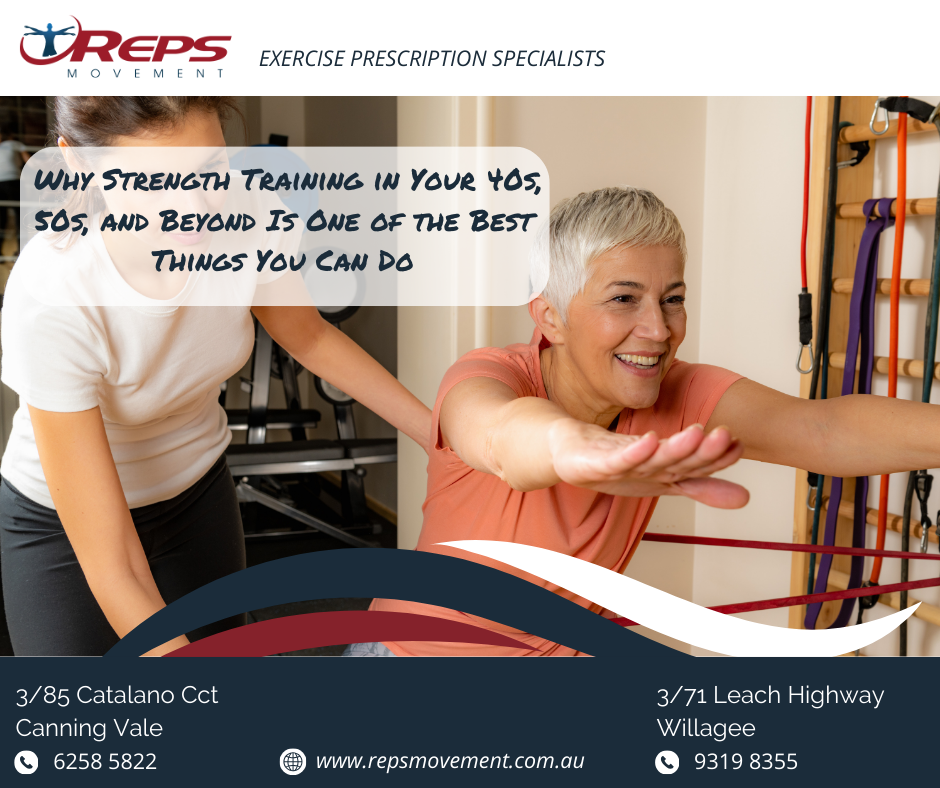
Effective strength training doesn't mean you need to figure it out on your own. Whether it involves resistance bands, free weights, machines, or your own body weight, what matters most is progressive overload — gradually increasing the challenge over time so your muscles continue to adapt and grow stronger. Having the right environment and expert guidance makes that process safer, more effective, and a lot more enjoyable.

A well-designed program will target the movements that matter most for everyday life: squatting (think getting in and out of chairs), pushing, pulling, carrying, and balancing. It should be tailored to your body, your goals, and any conditions you’re managing — whether that’s arthritis, back pain, a heart condition, or simply being new to exercise.

This is where working with an Exercise Physiologist makes a real difference. We’re university-trained health professionals who specialise in prescribing exercise for people with chronic conditions, injuries, and complex health needs. We don’t give you a generic program from the internet — we assess where you’re at, understand your goals, and build a plan that’s safe, effective, and designed to progress with you.

Ready to Build Your Strength?

Already a REPS Movement member?

Chat with your Exercise Physiologist at your next session about how your current program is targeting strength and what adjustments might help you get even more out of your training. If you’ve been focused on flexibility or endurance, now might be the perfect time to explore how we can layer in more progressive resistance work.

Been a while since your last visit?

Life gets busy — we get it. But your muscles haven’t forgotten how to get stronger, and neither have we. If you’ve been meaning to get back into a routine, consider this your invitation. Give us a call or book online, and we’ll pick up right where you left off — no judgement, just support.

New to REPS Movement?

If you’re curious about how strength training could help you feel stronger, more confident, and more capable in your daily life, we’d love to chat. Our Exercise Physiologists work with people of all ages and fitness levels — including those accessing services through Medicare, NDIS, My Aged Care, workers compensation, or private health. Book an initial consultation at our Willagee or Canning Vale clinic and let’s build a plan that works for you.


Your body is capable of more than you think. The research is clear, the science is on your side, and the right support makes all the difference. Whether you’re 42 or 82, the best time to start building strength was yesterday. The second best time is today.

REPS Movement
Exercise Physiology | Remedial Massage | Pilates
Willagee & Canning Vale

Contact us today to discuss how we can support your brain health through evidence-based exercise prescription.