Contact Us

Phone
${phone}

Email
info@repsmovement.com.au

Address
${address}

Online Enquiry

* Required fields

The real reason getting up feels harder than it used to

27/04/2026

You've said it. Most of us have. You go to get up from the couch and notice it takes a little more effort than it used to. You carry the groceries in and your arms feel it for the next two days. You go to stand from a low chair and have to use your hands to push yourself up. And the thought that crosses your mind?

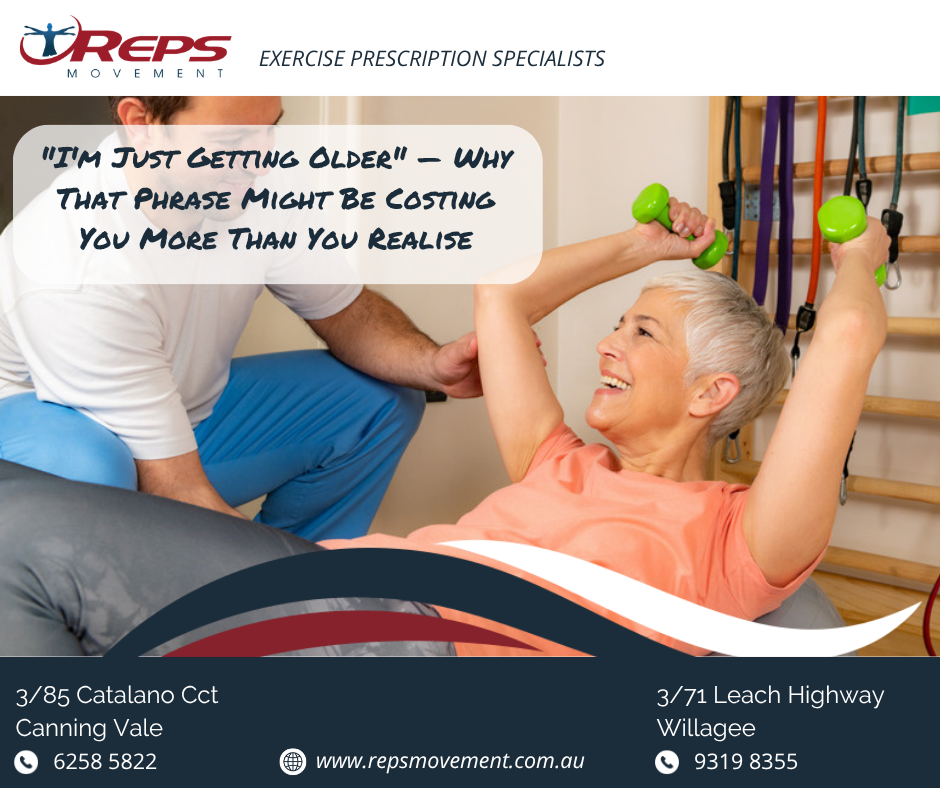
"I'm just getting older. This is normal."

It is common. But here's what the research is now making very clear, much of what we write off as "just ageing" is actually something more specific, more measurable, and far more treatable than most people realise.

It's called sarcopenia. And understanding it might be one of the most important things you can do for your health right now.

So, What Is Sarcopenia?

Sarcopenia, from the Greek meaning "loss of flesh" is the progressive decline in muscle mass, muscle strength, and physical function that occurs with age. It's not simply feeling a bit stiff in the morning or taking longer to warm up before a walk. It's a recognised medical condition, formally defined by global working groups, that affects how your body moves, responds, and recovers.

Under normal physiological conditions, human skeletal muscle mass reaches its peak at around 25 years of age. From there, the number and volume of skeletal muscle fibres begin to decline, with the rate of loss gradually accelerating with age. By the time most people notice something feels "off," the process has already been quietly underway for years.

After a person turns 30, the average rate of muscle mass decrease per decade can be as high as 8%. That might sound modest in isolation, but across two or three decades it accumulates into something significant, particularly when it begins to affect your ability to do the things that matter most to you.

The Numbers Are More Significant Than You'd Expect

Sarcopenia isn't a rare condition reserved for the very elderly. Research indicates that sarcopenia affects between 5% and 13% of individuals aged 60 to 70, rising to between 11% and 50% in those aged 80 and above. And while it has traditionally been linked to advanced age, recent evidence suggests it can begin developing as early as midlife — before the age of 60.

This is why the "I'm just getting older" response can be so costly. By the time symptoms feel undeniable, significant muscle tissue may already have been lost, tissue that takes consistent, targeted effort to rebuild.

Why It's About More Than Looking Fit

This is where a lot of people get sarcopenia wrong. It's not about aesthetics, gym goals, or achieving a certain physique. It's about what your muscles actually do for you every single day.

Muscle tissue is your body's engine for movement, metabolism, and resilience. Strong muscles support your joints, reduce your risk of falls, help regulate blood sugar, and allow you to recover from illness, surgery, or injury more effectively. Loss of muscle strength has been proposed as a powerful predictor of mortality and has become recognised as a new vital sign of health.

Sarcopenia is now internationally recognised as a health risk for older adults and is associated with increased adverse events including diabetes, risk of falls and hospitalisation, disability, psychiatric problems, and mortality.

Put simply, your muscle mass is not just about what you can lift. It is directly connected to how independently, actively, and fully you're able to live.

Here's the Part That Changes Everything

Sarcopenia is largely preventable. And for those who already have some degree of muscle loss, the trajectory can be reversed.

This is not wishful thinking — it is one of the most consistently replicated findings in exercise science. Resistance training is the most effective intervention for improving muscle mass and strength in older adults, with high-quality evidence supporting its role in both prevention and management of sarcopenia.
The research parameters are increasingly clear. To enhance muscle mass, resistance training should be performed more than three times a week at moderate to high intensity, with each session including 2–3 sets of 10–15 repetitions, sustained over at least 24 weeks. And it doesn't need to be intimidating, appropriate exercise prescription means starting where you are, not where someone else is.

High-quality evidence shows that resistance exercise combined with aerobic and balance training is among the most effective interventions for improving quality of life in people with sarcopenia. It's not one-size-fits-all and the best outcomes come from programs that are tailored, progressive, and supervised.

The critical word here is progressive. Short-duration programs are unlikely to allow older people to become familiar with the habit of exercising and don't enable sufficient progression of the exercise dose. At least 12 weeks of resistance training appears necessary to generate meaningful benefits. This is a long-game strategy, not a quick fix and that's actually good news, because the changes it produces are real and lasting.

What About Recovery? That's Where Remedial Massage Comes In

One of the most underrated components of any muscle-building program, particularly for those starting or returning to exercise later in life, is what happens between sessions.

When your muscles are adapting to new demands, they need circulation, release, and recovery support. Massage works on both the muscles and surrounding connective tissue, helping to ease tension and reduce adhesions that can limit movement. Regular sessions may help muscles and tendons become smoother and looser, potentially allowing movements to become easier and more coordinated.

Massage is also thought to increase circulation by alternately compressing and releasing the muscles, helping to get oxygen and nutrients to your tissues, something that becomes increasingly important as the natural efficiency of circulation can slow with age.

There's also the relationship between recovery quality and consistency. When exercise feels less gruelling and more manageable, people stick with it. That's not a minor detail in the context of sarcopenia, consistency over months and years is what actually moves the needle.

Why This Matters for You

If you're in your 40s, 50s, 60s, or beyond, the question isn't really whether muscle decline is happening. The question is whether you're doing something to influence how it unfolds.

The science is clear that the body responds to the right stimulus at any age. Muscle tissue remains adaptable well into later life, it just needs appropriate, targeted, and consistent effort to do so. The earlier you start, the more you preserve. But even starting now makes a meaningful difference.

This isn't about becoming an athlete. It's about staying strong enough to play with your grandchildren, confident enough to take on stairs without hesitation, and independent enough to live life on your own terms for longer.

What to Do Next

Already a member at REPS Movement? Talk to your Exercise Physiologist at your next session about whether your current program is specifically addressing muscle mass and strength. If you haven't heard the word "progressive overload" in your sessions recently, it might be worth a conversation.

A past client thinking about returning? We understand life gets busy, and returning to exercise after a break can feel daunting, especially if things feel a bit harder than before. That's actually the most important reason to come back. Our team will meet you exactly where you are. Reach out and let us know — we'd love to help you reconnect.

New to REPS Movement? If this article has resonated with you, a one-on-one consultation with one of our Exercise Physiologists is the ideal starting point. We'll assess your current baseline, explain what's actually happening in your body, and build a program specifically designed for where you're at and where you want to be.

Muscle loss is not inevitable. The story your body is telling you right now isn't the final chapter, it's an invitation to respond. And with the right support, the response can be remarkable.