

You've got the membership and a routine you know by heart, and most days you leave feeling better for it. Yet some questions never quite go away. Is this actually helping your knee, or quietly making it worse? How hard should you be pushing with your blood pressure? And why has your progress stalled since winter?
If this sounds familiar, you're not alone, and you're not doing anything wrong. Turning up is the hardest part. What a gym can't do on its own is tell you whether the work you're putting in is the right work for your body. That’s where an Accredited Exercise Physiologist comes in.
The Space and the Plan
What a Gym Gives You, and What It Can't
A good gym gives you equipment, room to move and the freedom to train when it suits you. That matters, because consistency is one of the biggest drivers of results.
But equipment on its own can't tell you which exercises suit your back, how much load your shoulder is ready for, or when it's time to progress. Think of a well-stocked pharmacy. Every medicine is on the shelf, but you still need someone to write the prescription: which one, how much, how often, and when to change the dose. When the medicine is movement, that's the job of an Accredited Exercise Physiologist.
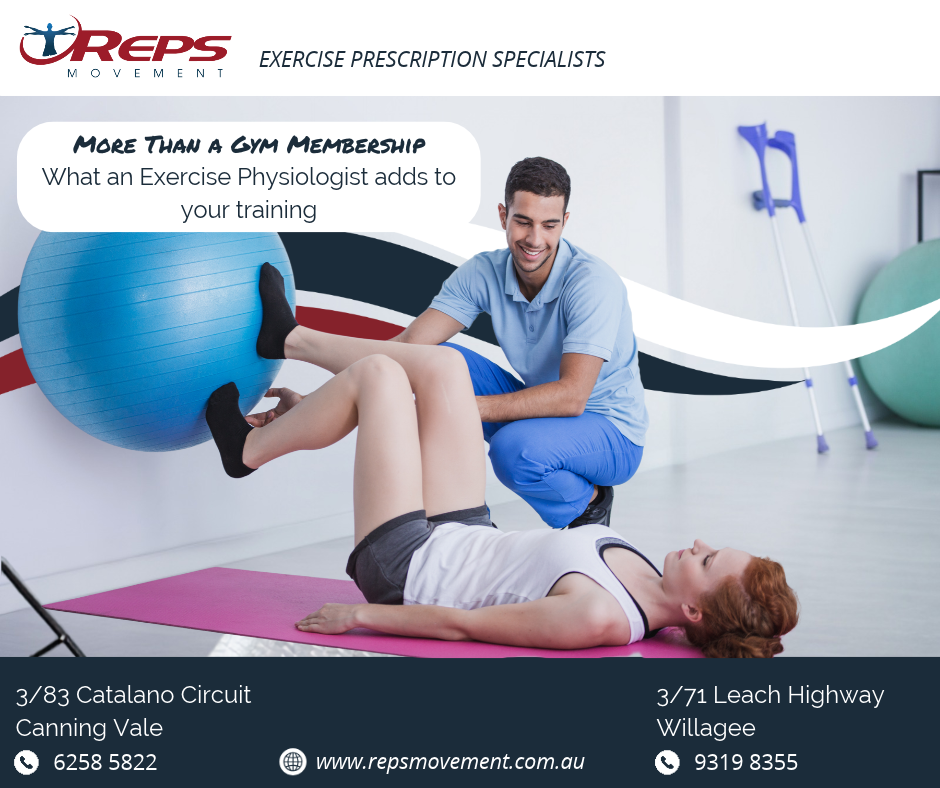
More Than a Gym Membership
Exercise Physiologist vs Personal Trainer: What’s the Difference?
Accredited Exercise Physiologists are university-qualified allied health professionals, part of the same family as physiotherapists, dietitians and podiatrists. To be accredited by Exercise & Sports Science Australia (ESSA), they complete at least four years of university study and at least 500 hours of supervised practical experience, learning how to adapt exercise safely for people living with health conditions.
That's the key difference from a personal trainer. Good trainers are great at helping healthy people get fitter. Exercise Physiologists are trained to work with chronic conditions, injuries and complex health needs, which is why their services are recognised by Medicare, the Department of Veterans' Affairs (DVA), the NDIS and workers compensation, and are included in many private health extras policies.
Built Around You
How Your Exercise Physiologist Designs and Reviews Your Program
Everything starts with an assessment. Your Exercise Physiologist asks about your health history, conditions and medications and, just as importantly, what you want to be able to do. Then they look at how you move and test your strength and balance.
From there, they design a program that's genuinely yours. If you're coming back from a knee replacement, it rebuilds strength around the joint at a pace the joint can handle. If you simply want to keep carrying the shopping and getting down on the floor with the grandkids, it focuses on the strength and balance that make that possible.
Then comes the part a gym can't do on its own: they review your program as you go. As you get stronger it progresses, and if a flare-up, a new diagnosis or a change of goal comes along, the plan changes with you. If it's been a while since anyone looked at what you're doing in the gym, that's worth raising with one of our Exercise Physiologists.

Why This Matters
Tailored, Supervised Exercise Gets Better Results
Half of all Australians now live with at least one chronic condition, according to the Australian Bureau of Statistics, and back problems and arthritis are among the most common. Exercise is one of the most effective treatments for many of them, but like any treatment, the dose matters.
Supervision makes a real difference too. A 2017 review in the journal Sports Medicine pooled studies of older adults and found that supervised strength and balance training improved strength and balance more than unsupervised programs did. The supervised groups didn't attend any more often, so the extra benefit seems to come from each session being done well and pitched at the right level. The researchers recommended making supervised sessions part of the mix, such as two of every three sessions in a week.
Better Together
Why Your Gym Membership and Your Exercise Physiologist Work Best Side by Side
None of this makes the gym the lesser option. A program is only as good as the sessions you actually do, and many of those happen between appointments. That's why we keep the two under one roof: you can train in our 24-hour gym knowing your program was built for you, and when something changes, the people who designed it are only a booking away.
Help With the Cost
Medicare, DVA and Other Ways to Fund Exercise Physiology
Because exercise physiology is an allied health service, there are several ways it may be funded. If you live with a chronic condition, your GP may be able to prepare a GP Chronic Condition Management Plan, which gives you up to five Medicare-subsidised allied health sessions each calendar year. Those five sessions are shared across all allied health services, so it's worth talking with your GP about how best to use them.
DVA clients may be eligible for exercise physiology too. A Veteran Gold Card covers clinically necessary treatment for all conditions, while a Veteran White Card covers treatment for your accepted conditions, which you can check in your MyService account. You'll need a referral from your GP, which covers up to 12 sessions or one year, whichever comes first, and your GP can renew it if you still need care. Providers who accept your Veteran Card are paid directly by DVA and can't charge you a gap fee.
We also see clients through the NDIS, My Aged Care and workers compensation, as well as privately. If you're over 50, ask about our Strength for Life program. Speak with our team or your GP to find out what's covered for you.
Practical Takeaways
Getting the Most From Your First Session
- Bring a list of your health conditions and current medications.
- If your GP has referred you through Medicare or DVA, bring the referral with your Medicare card or Veteran Card.
- Think of one or two everyday things you'd like to do more easily, such as climbing stairs, gardening or getting back to golf.
- Wear comfortable clothes and shoes you can move in.
- If you already train in the gym, bring your current routine so we can build on what's working.
Exercise That Fits You
You Don't Have to Work It Out on Your Own
Whether you're managing a chronic condition, coming back from an injury or simply wanting to stay strong as you age, the right program makes your effort count. Where you are now isn't where you have to stay, and you don't need it all figured out before you start.
For our current members: If you train in our gym on your own, book a session with one of our Exercise Physiologists to have your program built around your health and goals. If you already have a program and your goals have changed, ask for a program review.
For past clients: We'd love to see you back. Book an assessment and we'll start from where you are now, and check whether Medicare, DVA or another funding option can help.
For those new to REPS Movement: Book an initial Exercise Physiology assessment at our Willagee or Canning Vale clinic. If you have a chronic condition or a Veteran Card, ask your GP about a referral first and bring it along.