Contact Us

Phone
${phone}

Email
info@repsmovement.com.au

Address
${address}

Online Enquiry

* Required fields

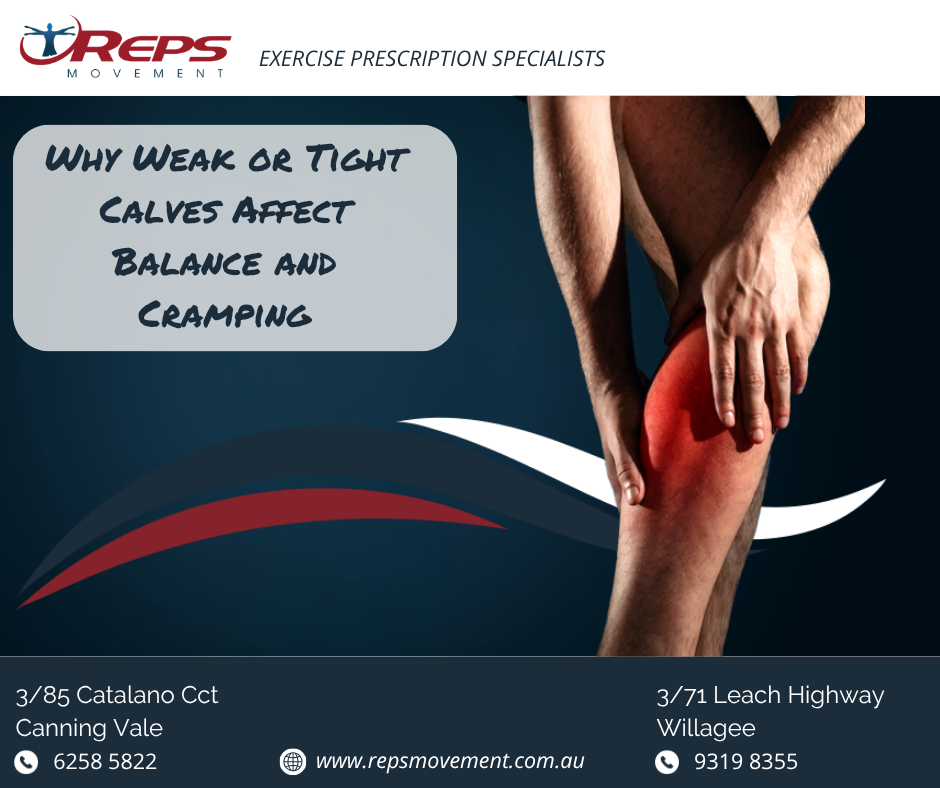
Weak or Tight Calves: Cramps & Balance

15/06/2026

Have you ever woken up in the middle of the night with your calf seizing into a tight, painful knot? Or noticed that your calves feel constantly tight, no matter how much you stretch, yet somehow still feel weak when you try to push up onto your toes? Maybe you've felt a little less steady on uneven ground, or more cautious going down stairs than you used to be.

If any of this sounds familiar, you're not alone. Calf tightness, calf weakness, cramping and balance issues are some of the most common (and most underestimated) things we see in clinic. The good news is that they're also some of the most responsive to the right kind of exercise and stretching, once you understand what's actually going on.

Your Calves Do a Lot More Than You'd Think

It's easy to think of your calves as "just" the muscles that help you walk, run or push off the ground. In reality, they're doing far more behind the scenes.

Every time you take a step, your calf muscles help control how your shin moves over your foot, absorb load, and propel you forward. They also play a key role in circulation, acting almost like a second pump that helps push blood back up from your lower legs. And perhaps most relevant to today's topic, they're a major contributor to your balance and proprioception, the sense of where your feet and ankles are in space without having to look down.

When your calves are weak, tight, or both, all of these jobs become harder. Your body often compensates in ways you don't notice at first, until it shows up as cramping, stiffness, or that nagging feeling of being a bit less stable than you used to be.

Tight Calves and Weak Calves Are Often the Same Problem

One of the things we explain to clients regularly is that tight calves and weak calves usually aren't two separate issues. More often, they're two expressions of the same underlying problem.

When a muscle is weak relative to the demands placed on it, your nervous system often responds by increasing tone and tension in that muscle as a kind of protective strategy. The muscle feels tight, restricted, maybe even "locked up", but stretching alone tends to give only temporary relief because the tightness isn't really the root cause. It's a symptom.

This is why so many people who stretch their calves diligently still feel tight day after day. Without addressing the strength side of the equation, the tightness keeps coming back. Building calf strength is often what finally allows lasting flexibility.

The Calf and Cramping Connection

Cramping, particularly the sudden, gripping calf cramps that strike at night or during exercise, is something almost everyone experiences at some point. Research into exercise-related muscle cramps suggests they're rarely caused by just one thing. Instead, they tend to result from a combination of factors, with muscle fatigue consistently identified as one of the strongest contributors.

This matters because it links cramping back to the strength conversation. A calf muscle that fatigues quickly, because it isn't conditioned to handle the demands you're placing on it, is more likely to cramp during exercise, at the end of a long day on your feet, or even at rest overnight.

For people who experience regular nighttime calf cramps, particularly those over 55, research has found that a consistent routine of calf and hamstring stretching over several weeks may help reduce how severe those cramps feel, even if it doesn't always reduce how often they happen. Stretching during an active cramp can also help it ease more quickly.

The takeaway here isn't that stretching is pointless. It's that stretching works best as part of a bigger picture that also includes building genuine strength and managing fatigue.

Why Calf Strength Matters for Balance

This is where the "weak calves" piece becomes especially important, and where the research really stands out.

Studies looking at falls in older adults have consistently found that lower limb muscle weakness significantly increases fall risk, with some research showing the risk of a fall roughly doubling, and the risk of repeated falls more than tripling, in people with weaker lower limb muscles. Your calves are a key part of that picture, since they're constantly making tiny adjustments to keep you steady, whether you're standing still, walking on a slightly uneven footpath, or recovering your balance after a stumble.

One study looked specifically at a structured program combining balance training with calf strengthening exercises in community-dwelling older adults. After just five weeks, participants showed meaningful improvements not only in calf strength, but in balance, functional mobility, and how confident they felt in their own balance day to day. Interestingly, the number of single-leg heel raises someone could perform was closely linked to how well they performed on other balance and mobility tests, making it a useful, simple marker of lower leg strength.

Why This Matters Day to Day

Bring all of this together, and a clearer picture emerges. Tight calves, weak calves, cramping and balance concerns aren't separate, unrelated annoyances. They're often connected threads of the same story: calf muscles that need more strength, capacity and resilience than they currently have.

The encouraging part is that this is highly responsive to the right kind of intervention. Improving calf strength can mean less reliance on "stretching that never seems to work", fewer cramps disrupting your sleep or your workouts, and more confidence on stairs, uneven ground, or simply standing up from a chair.

Practical Takeaways: Building Calf Strength and Flexibility Together

A well-rounded approach to calf tightness, weakness and cramping generally includes a mix of the following:

  • Calf stretching with both knee positions. A standing wall stretch with your knee straight targets the larger gastrocnemius muscle, while bending your knee slightly shifts the stretch to the deeper soleus muscle. Both matter.
  • Heel raises, progressed over time. Starting with two-legged heel raises and gradually building toward single-leg raises is one of the simplest ways to build genuine calf strength.
  • Eccentric loading. Slowly lowering your heel down from a raised position (rather than just lifting up) has strong evidence for building tendon and muscle resilience.
  • Balance practice. Simple single-leg standing, ideally near a wall or bench for safety, helps retrain the proprioceptive role your calves play.
  • Gradual progression. Sudden increases in walking distance, new exercise routines, or standing time are common triggers for both tightness and cramping. Building up gradually gives your calves time to adapt.

Frequently Asked Questions

Can weak calves cause cramping?
Yes. Weak or under-conditioned calf muscles tend to fatigue faster, and fatigue is one of the most consistently identified contributors to exercise-related muscle cramps. Building calf strength and managing how quickly you progress your activity levels can both help.

Can tight calves affect my balance?
They can. Tight calves often limit ankle mobility, which can change the way you walk and how quickly you're able to make small balance corrections. In many cases, tightness is also a sign of underlying weakness, which research links more directly to balance and fall risk.

How do I know if my calves are weak?
A simple starting point is the single-leg heel raise. Research suggests that being able to perform around ten or more controlled single-leg heel raises on each side is associated with better balance and mobility outcomes. If you're finding this challenging, it could be worth getting your calf strength assessed to see how we can help you build toward it.

What This Means for You

If you're a current member at REPS Movement, this is a great conversation to have with your Exercise Physiologist at your next session. Calf strength and mobility work can often be added into your existing program with just a few targeted exercises, particularly if cramping or balance has been on your mind.

If you've worked with us before but it's been a while, calf tightness, weakness, cramping or balance changes are exactly the kind of thing that tends to creep up gradually. If any of this has been niggling at you, it's a good reason to reconnect. We can pick up where we left off and build a plan around where you're at now.

If you're new to REPS Movement, calf strength and mobility issues are one of the most common (and most fixable) things our Exercise Physiologists assess. A first consultation gives us the chance to properly assess your calf strength, flexibility and balance, and put together a clear, individualised plan, whether you're dealing with persistent tightness, frustrating cramps, or simply want to feel steadier on your feet.

Your calves work hard for you every single day, often without much thought until something doesn't feel quite right. With the right support, they can go back to doing their job quietly and reliably, holding you steady, helping you move, and letting you get on with your day.

Call

📞 9319 8355 [Willagee]

📞 6258 5822 [Canning Vale]

Book Now

REPS Movement
Exercise Physiology | Remedial Massage | Pilates
Willagee & Canning Vale