Contact Us

Phone
${phone}

Email
info@repsmovement.com.au

Address
${address}

Online Enquiry

* Required fields

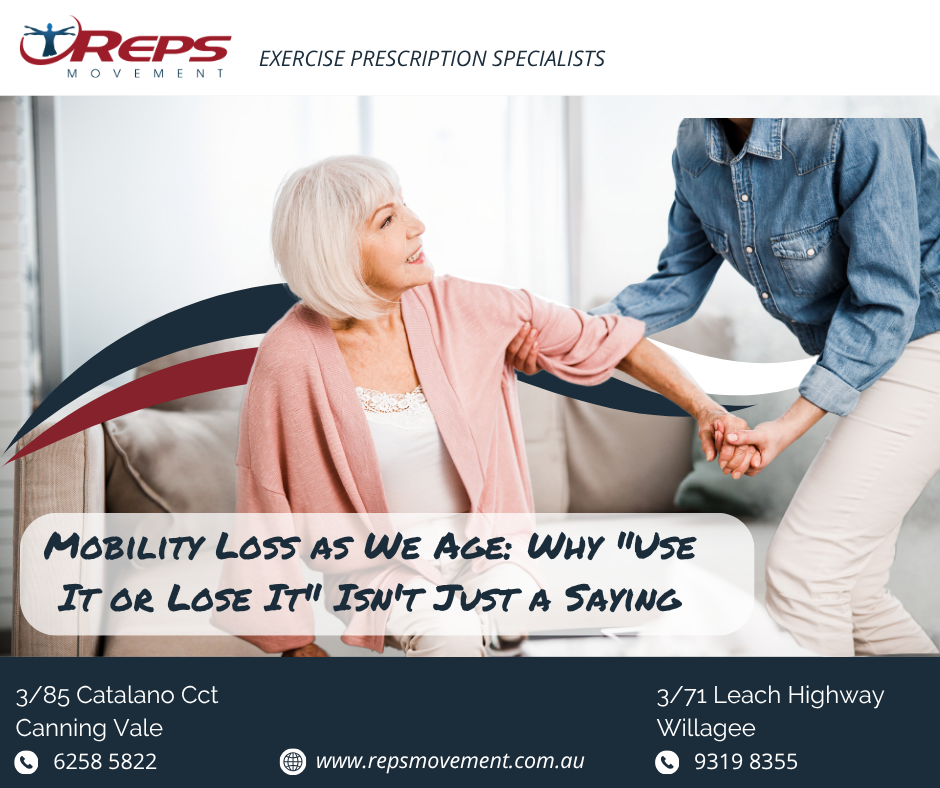
Mobility Loss as We Age: Use It or Lose It

19/08/2026

Getting down onto the floor to play with a grandchild. Reaching for something on the top shelf without a twinge in your shoulder. Standing up from a low couch without needing your hands. These are the kinds of everyday movements most of us never think about, until one day they feel a little harder than they used to.

If you've noticed your body doesn't move the way it once did, you're not alone, and you're not imagining it. Mobility naturally changes as we age. But here's the part that often gets missed: how much it changes, and how quickly, is far more within your control than most people realise.

This isn't about chasing the flexibility of your twenties. It's about understanding what's actually happening in your joints and muscles, why the instinct to "take it easy" can quietly work against you, and what the research says actually helps.

Why Mobility Changes With Age

As we get older, several things happen at once. Muscle mass and strength gradually decline, a process that accelerates if we become less active. Joints lose some of their natural lubrication and the surrounding tissue becomes less elastic. Balance and coordination systems, which rely on input from muscles, joints, and the inner ear, become less finely tuned.

None of this happens overnight, and none of it happens at a fixed rate for everyone. The research is clear that a sedentary lifestyle speeds these changes up considerably, while regular, appropriate exercise can slow them down, and in some cases partially reverse them.

The "Rest More" Myth

When a joint feels stiff or a movement feels harder, the natural instinct is often to protect it. Do less. Sit more. Wait for it to feel better before pushing again. It's an understandable response, but for most age-related mobility changes, it's the opposite of what helps.

Muscles and joints are a bit like a well-used pathway through a garden. Walk it regularly and it stays clear and easy to follow. Stop using it, and it doesn't take long before it becomes overgrown, and every step back through it takes more effort than the last. Movement keeps the pathway open. Inactivity lets it close over.

What the Research Actually Shows

The evidence here is substantial. Structured resistance training in older adults has been shown to meaningfully improve walking distance, lower body strength, and everyday walking speed compared with those who don't train. Broader reviews of exercise programs in older populations consistently find improvements across strength, mobility, balance, and gait, all of which translate directly into more independence in daily life.

Balance-focused and strength-focused programs in particular have been shown to reduce the risk of falls, one of the leading causes of injury and loss of independence in older adults. The encouraging message from all of this research is consistent: functional decline is not simply something that happens to you. In large part, it's something you can influence.

Recovery Matters Just as Much as the Exercise Itself

Building or maintaining mobility isn't only about the exercise sessions themselves. What happens between sessions matters too. Muscles that are worked need time and the right kind of support to recover well, and tight or overworked soft tissue can quietly undo some of the mobility gains you're working towards.

This is where a well-rounded approach makes a real difference. At REPS Movement, remedial massage works alongside your exercise physiology or Pilates program, not as a separate add-on, but as part of the same plan. It helps ease muscle tension, support recovery between sessions, and keep the tissue around your joints supple, so the mobility work you're doing in clinic keeps paying off at home. Remedial massage is now available at both our Willagee and Canning Vale clinics.

Why This Matters

Mobility isn't just about fitness. It's about independence. It's the difference between comfortably getting into and out of a car, playing on the floor with grandkids, gardening without paying for it the next day, and travelling without worry. Small, consistent investments in movement and recovery now have an outsized impact on how capable and confident you feel in your body for years to come.

Practical Takeaways

  • Consistency beats intensity. Regular, moderate movement most days does more for long-term mobility than occasional intense sessions.
  • Strength training isn't just for younger people. Resistance exercise is one of the most evidence-backed tools for preserving independence as we age.
  • Balance work deserves its own place in your routine, not just as an afterthought to strength training.
  • Recovery isn't optional. Supporting your muscles between sessions, through good movement, rest, and modalities like remedial massage, helps your body respond better to the work you're putting in.
  • If something has started to feel harder than it used to, that's information, not a reason to stop moving. It's worth a conversation with your Exercise Physiologist.

You're Not Stuck With Where You Are Now

However your mobility has changed, the story isn't finished. With the right support, most people can meaningfully improve how their body moves and feels, at any age and any starting point.

For our current members: If you've noticed certain movements feeling harder lately, mention it at your next session. Your Exercise Physiologist can adjust your program to specifically target mobility and address it before it becomes a bigger limitation.

For past clients: If it's been a while since you were last in with us, your body doesn't have to keep waiting. Reconnecting is easier than you might think, and we'll pick up right where's most useful for you now, not where you left off.

For those new to REPS Movement: If you've been noticing changes in how your body moves and aren't sure where to start, a consultation with one of our Exercise Physiologists is a low-pressure way to find out exactly what's going on and what can help.

Look after your body this spring: As part of our service awareness campaign, remedial massage is now available at both our Canning Vale and Willagee clinics. Purchase a 6-month membership and enjoy 10% off remedial massage, or renew for 12 months and save 15%. It's the perfect complement to your exercise or Pilates program, supporting recovery, easing tension, and helping you move better between sessions.
 

Call

📞 9319 8355 [Willagee]

📞 6258 5822 [Canning Vale]

Book Now

REPS Movement
Exercise Physiology | Remedial Massage | Pilates
Willagee & Canning Vale